Sunday, January 30, 2011

Naked


This week, we're reading selections from Intercourse, by Andrea Dworkin (referenced in at least one, if not both, of the Atlantic articles from last week), This Sex Which Is Not One, by Luce Irigaray, and if we have time, the last chapter of James Joyce's Ulysses.

The first chapter we're reading from Intercourse is called "Skinless," which is needless to say an attractive image to start off with. Dworkin's powerfully sensual style lends itself to descriptions of how the skin dissolves in the act of sex. The skin represents physical boundaries and personal identity, both of which are lost during intercourse: "The skin is separation, individuality, the basis for corporeal privacy and also the point of contact for everything outside the self" (26-27).

So that's the title of the chapter. As it relates to sex and sexuality, nakedness reduces us to our most basic humanity: "Sex is the dim echo of that original nakedness, primal, before anything else that is also human" (27). According to Dworkin, men and women respond differently to nakedness:
"The men are tortured in their minds by the meaning of being naked, especially by the literal nakedness of women but also by their own nakedness: what it means to be seen and to be vulnerable. [...] The women are at ease being naked. ...being naked does not unnerve or expose her. [...] Men's nakedness is unbearable to them without the nakedness of a woman; men need women to survive their own nakedness" (40-41).
Dworkin maintains that men's inability to reconcile their nakedness is due to their obsession with identity. Men are self-absorbed; therefore, their sex is wrapped up in abstraction, in looking without touching, in thinking rather than feeling. Men can't really touch because touch is real, and what is real may not be what the man wants. Since men can't really touch, they can never really dissolve their skin, lose their boundaries, and fuse with another person. Throughout the chapter Dworkin examines these ideas in the work of author Kobo Abe, and one of her examples is a man who barricaded a woman in a house with him and shut off the electricity so that in the dark, as long as he didn't touch her, he could pretend she was naked and be comforted, because:
"The women are the escape route from mental self-absorption into reality: they are the world, connection, contact, touch, feeling, what is real, the physical, what is true outside the frenetic self-involvement of the men, the convulsions of their passionate self-regard" (42).
So female sexuality, female nakedness, is earthly and corporeal. Women live in the body while men live in the mind, according to Dworkin. This is interesting to consider because depending on the context, this is either in keeping or in opposition to the widely held belief. Our modern romantic ideas perpetuate the image of women being the aloof lover, the abstracting lover. Women relent to men's demands of physicality indifferently, reluctantly, and only partially. Men require touch and body and often don't think beyond it. However, in religious stories like that of Eve, Lilith, and Mary Magdalene, and in historical perceptions of women, the idea that females were constantly at risk of falling off a sexual precipice prevails. Men were enlightened, rational, leading "the mental life," while women were emotional, subject to fits of hysteria (in other words, excessively physical) and had to be chaperoned whenever men were present lest they abandon themselves to passion.

Wednesday, January 26, 2011

Parasites

Today we're moving on to the second Mary Butts piece, "From Altar to Chimney Piece." Hopefully it will make a little more sense than "Brightness Falls." Last time I forgot to give a bit of background, so here are the basics now, right from Wikipedia: she was a British modernist writer and lived from 1890 to 1937. After her death, her work fell into obscurity, revived in the 1980's with the reprinting of her memoir. She lived in Paris for much of the same time period as Stein, and it is with post-WWI Paris that "From Altar to Chimney Piece" begins.

The first few pages of the story describe the quarter of Paris known as Montparnasse, and it sets up a clear conflict. We're introduced briefly to Vincent, a young man (an English soldier, we're led to believe) who falls in love with a female-personified Paris, specifically Montparnasse. It serves as a "supreme tonic" for the health of body and spirit:
"He found a quarter in a princess of cities where people were being good because they were being happy, because, after the lost years, a small tide of earthly joy was rising gently in that place. Or winding in and out of it like a little stream no evil thing could cross. A place where, even if people suffered, a touch of rapture, as though the pain was about something real, a necessary part of something like immortal life. A place where men and women were beginning to live again, beginning to make up for the years that the War had taken" (234-235).
These people are the artists and the lovers and they love the old delights: "love of a party, work, solitude, study, indolence, or an exhilarating row. Love of loving Paris, of good wine, good food; love of one's friends, one's enemies, one's beloved. The lovers went..." (236) and with them the tonic provided by Montparnasse. They're replaced by "imitators and failures" who effectively create a tourist trade:
"parasites on all the arts and all the passions, the men and women harlots and the fashionable purveyors of sexual excitements disguised as art. And with these, their panders, not of social or sexual tastes, but the neurotic vices which follow fashion and have nothing to do with desire. Also the men and women whose hell had not been occasioned by any dislocation of our society, but by the putrid state of their subconscious selves, occasioned by fear, by over-indulgence and sometimes by the intolerable repression of american life." (236).
These parasites are seeking the tonic, but instead of adapting themselves to the quarter they adapt the quarter to them, completely defeating the purpose.

After this introduction, we return to Vincent, and his life is described as never quite full after the War: "He did his duty as a small country gentleman, kept up his classics, his science, his contemporary letters, his friends. Had neither--and he noticed the omission--either love-affairs or any work that implied creation. Not up to the limit of his powers. [...] "They castrated me, after all," he used to tell himself" (238). Though gentle, he's no hero, no extraordinary figure.

There's an anecdote of a dream Vincent has where he is a fish explaining why he doesn't mind that he's unemployed, and as he runs away, he turns into the little mermaid from the original Hans Christian Anderson story, for whom walking on two legs was like walking on knives: "But that was for love's sake. For what love was he bearing a life-time's loss of honorable employment? For a love which had left the earth?? Gone off somewhere behind a space-time curtain into the inconceivable?" (240). Very interesting.

The next sentence is: "It was this that drew him and his friends to artists." This, this sense of absent but still influential love. Montparnasse and the lovers and artists there were his tonic, his answer to what that missing love was: remember the list of "old delights" quoted above. Or perhaps he envies the artists for their "essential health." It seems that Vincent is sometimes envious of full people and their ability to live: "He sneered, as near as he ever came to a sneer, at [life] and his inability to yield to it" (242).

The rest of the story goes something like this: Vincent meets an American girl named Cherry, falls for American girl, loses American girl to a bad crowd, moves on with his life. Interestingly, though, the bad crowd meets in a salon like the ones Stein and her brother would hold for the famous and would-be famous artistic and literary figures of Paris. Is Mary Butts implying that Gertrude Stein was some kind of evil gang leader? Hard to tell.

Tuesday, January 25, 2011

Assonance

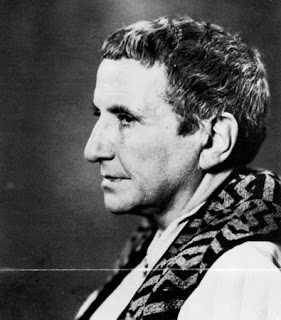
So I've been reading The Autobiography of Alice B. Toklas, aka the autobiography of Gertrude Stein, not closely, but just to get a sense of the woman to inform my readings from Mary Butts' short story collection, From Altar to Chimney Piece. As I said before, the essence of Stein seems to be her perpetual amusement. Not to say that she can't be serious, but she's so endlessly amused by life. Also, the story of Stein's life is as much about her friends' biographies as hers; her history is a timeline of people she's met. As for the style of the book, there are a lot of digressions into various anecdotes. It's the autobiography of a gossip.

Someday, I will finish the whole thing. But now, on to Mary Butts. The first piece is a short story called "Brightness Falls." First of all, the style is really sort of in your face; fast-paced and repetitive and conversational, like an excited rambling person. Also, on the first page we get this:
"When all's said and done, we do hang together against our women, and not wholly from rational reasons. All one finally discovers is that, when they urge us, the loveliest and wisest become all one with the slut" (203).
Interesting. Though it's not yet clear, I'm assuming the first-person narrator is male; and what's represented here is related to the prude-or-slut dichotomy which inspired this independent study.

I'm having a little trouble picking out things to talk about; there's been so little actual content thus far. It's like a drunk person telling a story and giving you all the irrelevant facts. So this post might just be a festival of quotes.
"It is getting more and more inopportune to suppose that women have no secrets unconnected with sex" (210).
Or just the above. I rather like it.

So having now finished, this is what I can gather. The story is a man named Max relating something to the unnamed, thus far un-gendered narrator, and that something has something to do with his wife obsessing over assonant sounds in "Corandel," "Coromandel," and "parallel." She hears these sounds, picks them out everywhere; she seems to have some psychicness attached to them: she wants to intercept her friend Cynthia with Dr. Corandel at the Lincoln Inn, and she knows "it [will] be in Lincoln's Inn, because in Lincoln's Inn there was a map of the Coromandel Coast" (211). Very strange. On 213 Max describes his wife: "Parmys looked coarse; and again that was because Parmys was like an archaic goddess stored with raw power. Not my wife, not Cynthia's friend and belle-femme, but something that is in the foundation of wise woman and child." So there seem to be some connections to female mysticism. This is reinforced by the conclusion to Max's story, in which Parmys and Cynthia have somehow prevented Corandel and his assonant sounds from invading a "place," apparently some parallel dimension, that travels along with and slightly ahead of them. Max is briefly able to "see" this place.

I'm going to be frank; this story is hella confusing. Fascinating to consider narratively, but since all the information is secondhand the most I can glean is that women have almost preternatural connections with the world and each other, and men only understand sometimes.

The One Insane Taboo

Today our reading is an article called "Hard Core" from The Atlantic. The article explores the relationship between porn and our sexuality, and I suggest you read it for yourself. I think the best way for me to approach discussing this is to take just the quotes that stand out to me.
"MEn, so the conventional wisdom goes, tend to desire more than women are willing to give them sexually. The granting of sex is the most powerful weapon women possess in their struggle with men."
We saw a bit of this in the Duke article from yesterday, as we see it in our daily lives. It's rare to find a man, virgin or not, who wants to "wait" in a relationship. We know this not just from stereotypes, but from personal experience. Only once have I personally known such a man; and
we're not talking about men who will wait until the woman is ready, but rather the man who tells the woman that he is not ready.

As for the granting and withholding of sex being a powerful female weapon, that's true too.

"But the reactionary political correctness of the 1990s put forth a proposition even more disastrous to women than free love: sexual equality."
The article argues that sexual equality, and the idea that by communicating our boundaries we could teach men to respect female sexuality, is an "intellectual swindle that leads women to misjudge male sexuality, which they do at their own emotional and physical peril." The argument that sexuality is not neutral stands in direct opposition to my pipe dream from the last post, but I'm okay with that; in our generation and the next couple at least, it's true. Societally, we embrace egalitarian sex because it makes us feel better, but:
"Internet porn, on the other hand, shows us an unvarnished (albeit partial) view of male sexuality as an often dark force streaked with aggression."
Porn, according to this article, shows us not a hyperbolic version of male sexuality, but the real thing, the brutishness that really underlies what we encounter. I find this a little extreme, but not impossible; the best sex, which stripped them of their shame, that Connie and Oliver had in Lady Chatterley's Lover was undoubtedly the roughest and least tender. The article says that this kind of sexuality is "unattractive" and sometimes "dangerous," but not deviant. Porn is not the source, but the result.
"It’s the clash between vulnerability and indifference that transpires after sex that is so savage. This is what Kael called “realism with the terror of actual experience.” The most frightening truths about sex rarely exist in the physical, but instead live in the intangible yet indelible wounds created in the psyche."
The article seems to wish porn were less pervasive, and I'm not sure I agree. I think the furtiveness with which sex and it's attendants have been treated in the past have contributed a lot to this vulnerability and indifference: fear of getting caught, pretending it didn't happen, etc. etc. We've achieved sexual openness. What hasn't happened yet is the combination of acceptance and morality to that openness. We know porn exists, but like sex, do we really think it's okay? Or do we just pretend to because it's the modern thing to do? We still lock the door, pull down the blinds, and test our headphones just to make sure no one but us will hear.

I don't have too much to say on this subject. It's exhausting.

I'm reminded of a quote from Lady Chatterley's, and that's what I'll leave you with:

“It’s the one insane taboo left: sex as a natural and vital thing” (291).

Monday, January 24, 2011

Protection

We're now into the second week of classes, and time is a precious commodity! The reading of The Autobiography of Alice B. Toklas is going slowly; Stein's style is dense. It doesn't feel complex or confusing to read, but I find myself crawling through the pages, so "dense" is the only descriptor I can think of. It's like wading through caramel: delicious, but a serious ritardando compared to Lady Chatterley's and especially Goblin Market.

So we're going to take a break and look at two articles from The Atlantic. The first is called The Hazards of Duke and discusses the "thesis" of a Duke University student named Karen Owen, who slept with 13 Duke athletes and then created a dense PowerPoint with her observations. Her exploits are what we think of as the typically extreme college hook-up, styled after the techniques of I Hope They Serve Beer in Hell author Tucker Max; their impetus was the worst possible kind of one-night stand--short, rude, unfulfilling.

I think the article isn't focused enough to be easily discussed, but the snippets of feminist discourse throughout did catch my eye. As Karen's project progressed it seemed to expand beyond just sex acts into favors; she was described as a fraternity's "ideal pledge," I assume by virtue of her complete submission to the boorish athletes she selected. The following quote stood out to me:
"If what we are seeing in Karen Owen is the realization of female sexual power, [...] What rotten luck that the first true daughter of sex-positive feminism would have an erotic proclivity for serving every kind of male need, no matter how mundane or humiliating, that she would so eagerly turn herself from sex mate to soccer mom, depending on what was wanted from her."
There's a long legacy of female power being subversive, behind the scenes; we have phrases like "Behind every great man, there is a great woman," and a favorite from My Big Fat Greek Wedding, "The man may be the head [of the family], but the woman is the neck." In that way, Karen's behavior is not so unfamiliar--but her kowtowing seems purposeless. What is the result of it? Nothing is preserved but gender roles, and nothing is changed but her reputation. We've been to these dark sexual places with Duke University before (remember the 2006 rape charges levied against three members of the lacrosse team?), so nothing is exposed. I don't understand her motivations.

The article argues that Karen is playing out an old story with her escapades: that she is trying to get revenge on the man (Subject 2 of her study) who took advantage of her, and her shame is manifesting itself in repetition of the humiliation. How does this sort of thing begin? In our liberation from curfews and segregated education and our practice of constantly striving to appear at our most [sexually] attractive, women, the article says, "have ended up with the protections of neither the patriarchy nor those old-school, man-hating radical feminists."

I long to live in a world where women don't need to be protected, but I believe it can only come with a radical change in perception and shift to gender-neutrality. Biologically speaking, women tend to be smaller and have less muscle mass than men, especially in the upper body. This will not change without some kind of physical catalyst and centuries of evolution. To counteract this disparity of actual, quantifiable strength, emphasis must be placed from birth on gender-neutrality. Dolls can't be bought for girls because they are girly, and trucks can't be bought for boys because they are boyish. The decor and toys surrounding a child can't be preemptively arranged or purchased, but only procured after discerning a positive reaction to it from the child. Language and attitudes would have to be closely monitored for leanings; a parent couldn't say "boys don't cry" or "girls don't yell."

Those are just some examples. It's unrealistic, however nice it might be to live in a world where from birth we define ourselves. For it to occur, an entire generation of childbearing adults would have to rigidly check themselves against unwittingly assigning gender, and for full realization, all previous generations would have to die out. Popular media would have to be completely retooled, etc. etc, etc. I believe that is the only way to keep women safe: if men never generalized women as weak, if women never generalized men as strong, protection wouldn't be required.

Unfortunately, I will probably never live to see a world in which I don't have to prove myself to a male population.*
"In [the past], we relied on our own good judgment to keep us safe, but also—and this is the terrible, unchanging fact about being female—on the mercy of the men around us."
Tomorrow, Hard Core.

*I'm obviously speaking in huge generalities. I have many close male friends from whom I have never lacked respect.

Friday, January 21, 2011

This is not about love.

The semester has now begun, and that means that some things about the blog are going to be changing. Since my readings now are compressed (a week for one-two novels, roughly speaking), I won't be able to be as thorough as I was with Lady Chatterley's Lover. This means I'll skip a lot of plot summaries and things, but I'll send you links when available of summaries from Sparknotes, Google Books and Amazon, etc., for those of you reading vicariously through the posts.

Our next set of readings includes The Autobiography of Alice B. Toklas, by Gertrude Stein, and two short stories by Mary Butts, "From Altar to Chimney Piece" and "Brightness Falls." The Autobiography is interesting so far. According to Donald Sutherland's review on the back cover, Stein wrote the autobiography "largely to amuse herself," and that impression is evident. Stein as perceived by Toklas appears to be outside the world, looking in and laughing coyly at what she sees. I'm really reading the novel to get a sense of her, so it's less a subject of study for me; instead, I'll use the background to inform my readings of Mary Butts, who was a contemporary of Stein's.

So until my next update (probably sometime this weekend, on two articles from The Atlantic: "The Hazards of Duke" and "Hard Core," if you'd like to read ahead of time), enjoy one of my favorite Fiona Apple songs, one I'm beginning to think of as a sort of theme song for the blog:

Tuesday, January 18, 2011

Sacrifice

So, when we last left the sisters of Goblin Market, Laura was cut off from the goblin fruit-sellers. She begins to waste away just like Jeanie, the girl in the story Lizzie told. Lizzie watches her sister's declining health with fear, and finally makes a decision:
"Till Laura dwindling
Seemed knocking at Death's door:
Then Lizzie weighed no more
Better and worse;
But put a silver penny in her purse,
Kissed Laura, crossed the heath with clump of furze
At twilight, halted by the brook:
And for the first time in her life
Began to listen and look" (33).
Lizzie previously had always covered her eyes and plugged up her ears, ignoring the sight and sounds of the goblin men and their cries. Now, she's seeking them out, opening her awareness, as it were, to temptation. The goblins cackle at the sight of her and scurry up: "Hugged and kissed her:/Squeezed and caressed her:/Stretched up their dishes,/Panniers and plates" (36). Lizzie tries to buy fruit in bulk to take back to Laura, but the goblins urge her to stay and eat with them. Lizzie stands her ground, though:
"'Thank you," said Lizzie: "But one waits
At home alone for me:
So without further parleying,
If you will not sell me any
Of your fruits though much and many,
Give me back my silver penny
I tossed you for a fee."--(39-40)
The goblins react badly; they drop their charming airs and snarl at her. They attack her, "Held her hands and squeezed their fruits/Against her mouth to make her eat" (42) in a scene that rings clearly of rape, with Lizzie "Like a royal virgin town/Topped with gilded dome and spire/Close beleaguered by a fleet/Mad to tug her standard down" (43). Despite it all, Lizzie keeps her mouth closed, "But laughed in heart to feel the drip/Of juice that syrupped all her face" (44). The semen imagery is clear, but Lizzie sustains herself throughout the attack and is not penetrated by the fruit or juices. Eventually, the goblins disappear and Lizzie hurries home.

When she gets there, she offers herself, covered in pulp and juice, to Laura: "Hug me, kiss me, suck my juices/Squeezed from goblin fruits for you" (49). Laura leaps up and kisses her sister for her perceived sacrifice and tastes again the goblin fruit.
"Her lips began to scorch,
That juice was wormwood to her tongue,
She loathed the feast:
Writhing as one possessed she leaped and sung,
Rent all her robe, and wrung
Her hands in lamentable haste,
And beat her breast" (51).
She's consumed entirely by the fruit again ("Ah! fool, to choose such part/Of soul-consuming care!" 52), her senses fail her and she collapses: "Pleasure past and anguish past,/Is it death or is it life?/Life out of death" (53). Lizzie keeps watch over her through the night, and when dawn breaks, Laura wakes and is as she was before she ate the goblin fruit. The last stanza is an epilogue in which Laura tells her children of her ordeal, and how her sister's virtue saved her.

FINAL THOUGHTS

Goblin Market is surprisingly explicit in its erotic imagery, what with all the sucking and the fire in breasts and everything. Rossetti depicts sexual desire as something evil, something which possesses and consumes a person, which makes sense in the context of Victorian morality and Rossetti's Anglican upbringing. The same flame that Oliver Mellors and Connie Chatterley embrace as a symbol of their love tears Laura apart. Despite its graphic description, this is all in all a more typical message of sexuality, more along the lines of what we expected from "classic" literature.